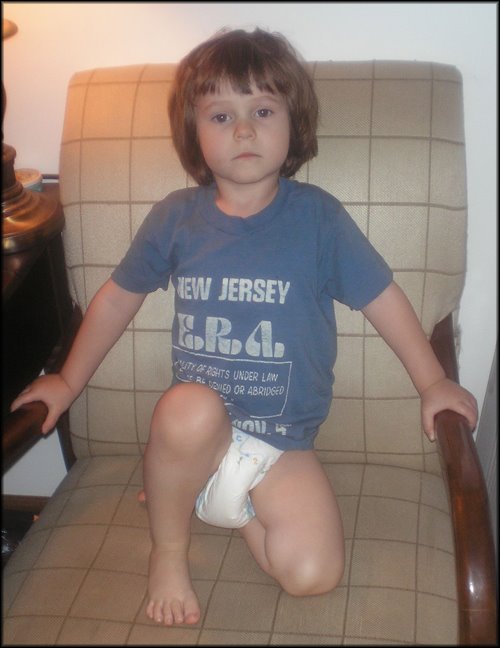
Declan scraped his leg and foot about three different times on Saturday, while trying to keep up with his turbo-cleaning parents. When he does something like bonk himself on the elbow, he’ll run to me, say “smooch it!” and go on about the day. But when blood is involved, he bites his lip and runs away, not wanting me to touch it, let alone clean or bandage it.
I struggled to get him into the bathtub that evening, a place he’s usually happy to visit. He gazed at the water lovingly, but resisted. “I don’t want a bath,” he told me repeatedly. After a while, he confessed the reason: “My foot still hurts.”
Looking at the small mix of blood and mud on his leg, I knew I had to get him into the tub.
“A bath can make your foot feel so much better,” I told him. It might sting a little bit when you get in, but in a few minutes, it won’t hurt as much.”
After more negotiation and a bit of pleading on my part, he opted to take my word for it. He stepped in, blinked his eyes a couple of times, then proceeded to enjoy his bath, as usual.
When I asked him how his scrapes felt a few minutes later, he surprised me with “you told the truth, mommy. You said it would sting a little bit and then it would feel better.”
“Is that what happened?” I asked him.
He nodded. “It feels better.”
I believe in the power of telling kids the truth. Not everyone agrees with me.
In a few days, a placebo pill for children will be available online. Named “Obecalp” (get it?), it’s apparently “designed to have the texture and taste of actual medicine so it will trick kids into thinking that they’re taking something.”
The product strikes me as insane. I know a few too many people who have looked at pills as a pat solution to ailments, and that approach only mired them in deeper problems. No matter how miraculous the cure that some pills offer may feel, pills are scientific, not magical things that you consume blindly. And outside of an infection or certain other temporary conditions, they shouldn’t be seen as a solitary answer to any condition. In my perfect world, there would be nutritional advice with every diagnosis, as well as advice on fitness, or any other relevant lifestyle habit. In my mind, a child with hypochondria probably has deeper emotional needs or problems (or is scarred by parents who choose to do things like LIE TO THEM ABOUT PILLS).
Granted, I am a person who could barely sit through the movie Life is Beautiful because the premise that the loving thing to do for a Jewish child in Nazi Germany was to lie about what’s really happening positively drove me up the wall. I don’t think lying is part and parcel of parenting. There are truths I have definitely sidestepped with Declan because I don’t think it’s necessary or wise to impart life’s harsh realities to a toddler, but I can’t imagine calculating the best way to lie to him convincingly. Besides, once they’re old enough to realize that they don’t actually disappear when they cover their own face with a blanket, children aren’t so easily duped.
What’s your take on this? Am I overlooking an instance where a placebo could be ethically used to help a child?
P.S. There was a good commentary on NPR by a doctor who is opposed to the product.

Copyright Tracy Zollinger Turner, Tinymantras.com, 2008.